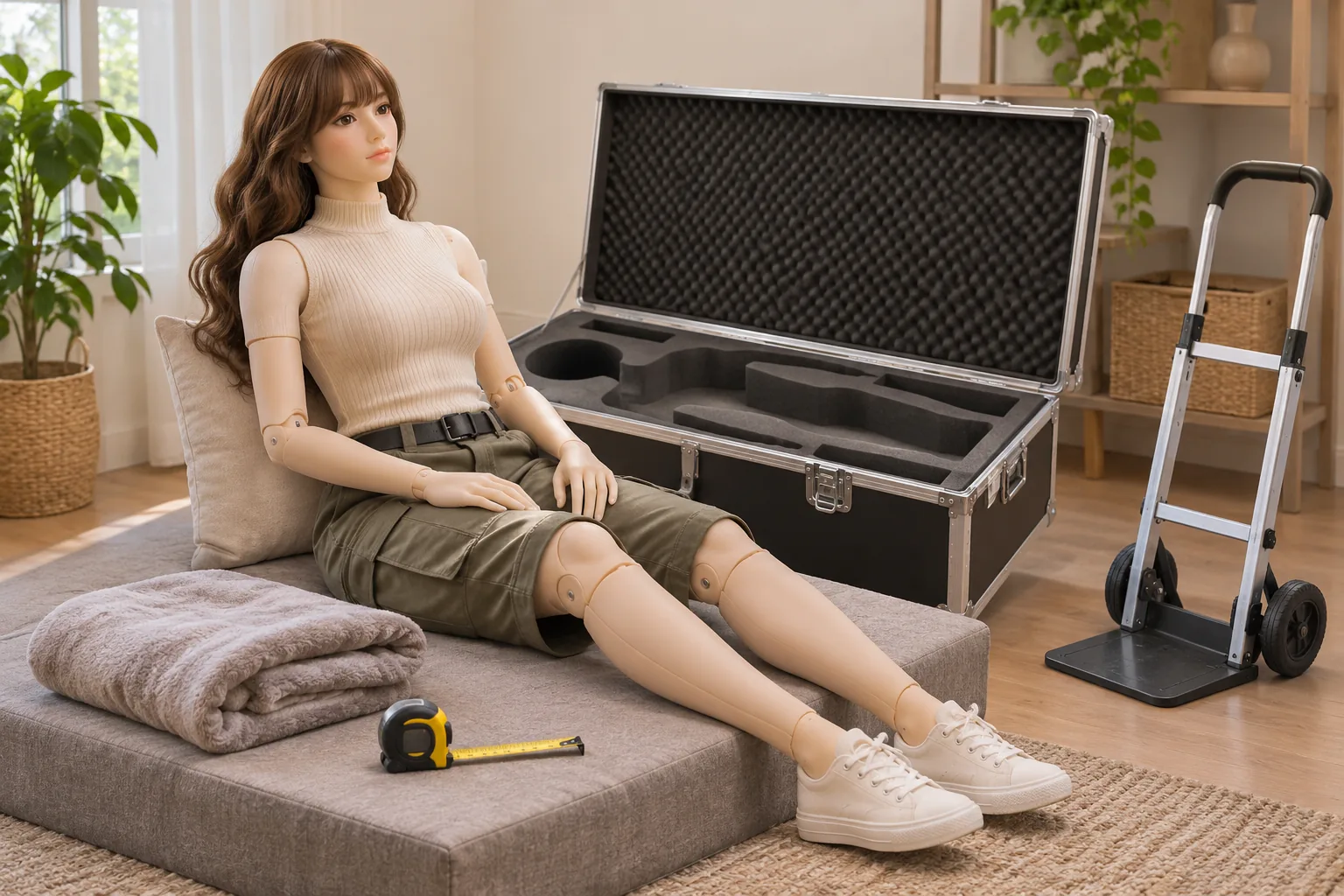
A doll can fit the dimensions on a product page and still be difficult to move, clean, and store. The listed weight does not show how the load is shaped, whether it has safe handholds, or how often it must be repositioned. A realistic plan starts before checkout.
Ask for both product and packed weight
The product's listed weight may differ from the delivered carton. Packing, a stand, accessories, and a reinforced case can add weight and bulk. Ask the seller for the packed weight and outer dimensions, and whether delivery is to a door, lobby, curb, or pickup point. Keep the written answer with your order information.
If a listing gives a weight range, ask which configuration it describes. A different frame, head, or removable component may affect the actual figure. Avoid assuming that a lighter option will be easy for one person to handle.
Treat shape as part of the load
A long, flexible object can be harder to control than a compact box of the same weight. A doll may have moving limbs, no handles, and joints that should not be used as lifting points. Stairs, narrow doors, and slippery floors add difficulty.
The CDC/NIOSH materials-handling guide recommends clearing the route, using equipment for heavy objects, and getting help with awkward loads. It was written for construction work, so its example weight limit should not be treated as a personal safety threshold. OSHA's lifting guidance explains why reach, twisting, frequency, carrying distance, and poor grips change the risk even when the weight stays the same.
Walk the entire route before delivery
Measure doors, hallways, stairways, corners, and the space beside the intended storage area. Plan where you can open the carton without blocking an exit. Clear trip hazards and protect sharp corners before the package arrives.
A hand truck may help move a closed carton on an appropriate surface. It does not automatically make an unboxed doll safe to move; the product needs proper support and protection. If stairs or tight turns are involved, arrange help before delivery rather than improvising when the carton arrives.
Plan the repeated lifts
Delivery is only the first handling task. Cleaning, dressing, repositioning, and returning the doll to storage may require the same effort again and again. Choose a cleaning place that minimizes carrying, and keep towels and material-compatible supplies nearby. Review our cleaning and storage guide before deciding where the product will live.
Follow the model's instructions for detachable parts, joints, hanging points, and storage position. Do not pull on a wrist, ankle, finger, or head to move the entire weight unless the manufacturer specifically identifies it as a safe lifting point.
Check the storage support
A stand, hanging system, case, shelf, or other support should be designed for the product and rated for the expected load. Confirm the manufacturer's approved attachment points and whether the support remains stable as the doll is placed or removed. A lightweight closet rod, folding table, or improvised hook may be unsuitable even when it appears to hold the weight at rest.
The TPE versus silicone guide explains material differences; neither material choice replaces a handling plan. Consider the whole routine, including drying and pressure-free storage.
A pre-order handling checklist
- Confirm the product weight, packed weight, and carton dimensions.
- Check the delivery location and any lobby, elevator, or pickup rules.
- Measure the route to the cleaning and storage areas.
- Decide who will help with heavy or awkward moves.
- Identify a compatible cart, stand, case, or storage surface if needed.
- Check how often the product will need lifting or repositioning.
- Choose a smaller or lighter model if the plan remains impractical.
No general weight number can tell every person what is safe to lift. If the route, grip, or repeated handling seems doubtful, arrange appropriate help or equipment and choose a product that fits your actual space and routine.